Lab-Grown vs Natural Diamonds
Laboratory-grown or natural. Both are diamonds, both sit on our counter, and the right one depends on what you want from the stone. Here is the whole thing without the sales pitch.
Alpoe London, Hatton GardenPublished Updated
Is a laboratory-grown diamond a diamond?
Yes. Chemically, structurally and optically the same as a stone pulled out of the ground. The only difference is where it was made. One took billions of years in the earth, the other took a few weeks in a laboratory. A lab diamond is not a fake diamond and it is not a simulant. It is diamond.
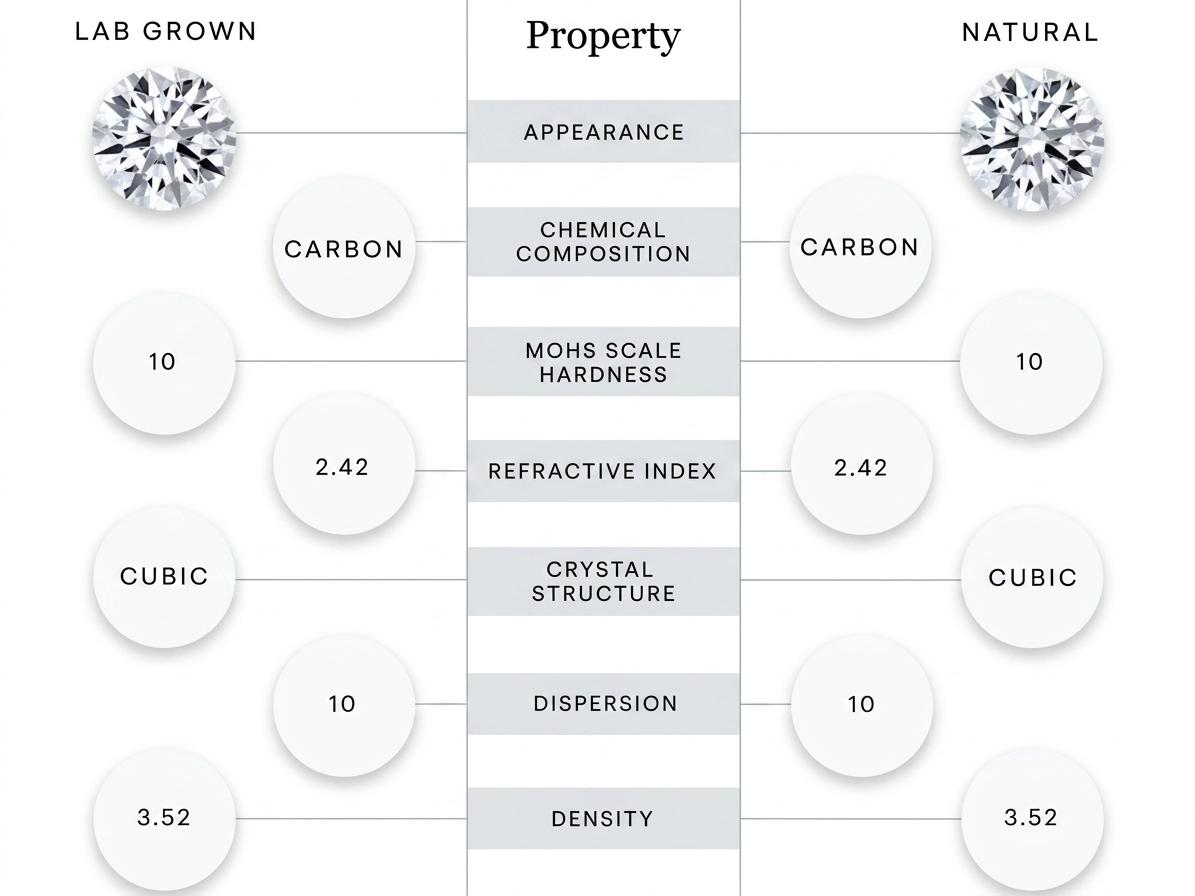
Measured side by side
Every property that matters is essentially the same
- Chemical composition
- Carbon
- Mohs hardness
- 10
- Refractive index
- 2.42
- Crystal structure
- Cubic
- Dispersion
- 0.044
- Density
- 3.52
Telling them apart takes laboratory equipment. Specialists look for nitrogen: natural stones pick up traces of it as they form, lab stones contain none.
How a lab diamond is grown
Two methods, both a few weeks from seed to rough. Both produce stones that are essentially the same as natural stones.
CVD
Chemical Vapour Deposition
Carbon rich gas is broken down in a chamber and the carbon settles onto a seed, building the crystal layer by layer.
HPHT
High Pressure, High Temperature
Carbon is dissolved under heat and pressure that copy the conditions in the earth's mantle, then crystallises around a seed.
What each one costs
A lab diamond runs 60% to 85% below a natural stone of the same carat and the same grades. Not because it is a lesser stone, but because it can be made to order and a mine cannot.
| Diamond | Cut | Colour | Clarity | Price |
|---|---|---|---|---|
| 1ct Natural | Excellent | D | VVS2 | £5,500 to £7,000 |
| 1ct Lab | Excellent | D | VVS2 | £1,100 to £1,500 |
Guide prices for loose stones. Market rates move, so we quote on the day.
So which one should you pick?
We sell both and we are not going to push you either way. These are the facts. The rest is what you want from the stone.
Go lab if
- Two to three times the carat weight for the same budget.
- Same cut, colour and clarity grades as natural, at the top end.
- Ready in weeks, so a bespoke build is not waiting on a stone.
- No conflict stone question to ask.
- Far less land disturbed than mining.
Go natural if
- Holds its resale position. Lab stones have no track record yet.
- Finite supply, which is what the price has always reflected.
- Billions of years in the ground, if origin matters to you.
- Well run mines are the income of the communities around them.
FAQS
Roughly two to three times the carat weight for the same money, at the same cut, colour and clarity grades. That is the main reason people choose lab, and it is why a budget that buys a 1ct natural will often buy a 2.5ct lab.
Yes, and you should not buy one that is not. Look for GIA or IGI. Both laser inscribe a number on the girdle that matches the certificate, readable at 50x magnification, and IGI marks lab stones as laboratory-grown alongside it.
Not by eye, and not with a loupe — a laboratory-grown diamond has the same optical properties as a mined one, so there is nothing to see. The pocket testers sold as diamond testers do not help either: they measure thermal and electrical conductivity to answer the question 'is this diamond', and a lab stone is diamond, so it passes. Telling the two apart takes specialist screening equipment that looks at growth structure and fluorescence, which is what the grading laboratories use. In practice you rely on the paperwork: GIA and IGI laser inscribe a number on the girdle that matches the certificate, and IGI marks lab stones as laboratory-grown. That inscription is the reason not to buy an uncertificated stone of either kind.
No. Moissanite and cubic zirconia are simulants. They are different materials that are made to look like diamond. A lab diamond is diamond. Simulants give themselves away on sparkle: cubic zirconia goes dull and can yellow with age, and moissanite throws rainbow flashes and looks hazy at larger sizes.
Nobody knows yet. Lab stones are too new for a resale track record. Natural diamonds hold their position better because supply is finite. Worth saying plainly: any diamond, lab or natural, resells for less than you paid.
They have fallen substantially since laboratory-grown stones became widely available, as production capacity grew and the technology matured, and the direction has been consistently downward rather than volatile. We will not put a number on where they go next, because nobody can — but it is the honest reason to buy a laboratory-grown stone for the size and the look rather than as something to sell on later. If resale matters to you, that is an argument for a natural stone. If wearing the largest, brightest diamond your budget allows matters more, it is an argument for lab.
The same way as any other ring, with one difference worth getting right. Jewellery is insured for replacement cost, so the sum insured should be what it would cost to replace the piece today rather than what you paid. Laboratory-grown prices have fallen since the market opened, which cuts both ways: an older valuation can have you paying premium on a figure well above what a replacement now costs, and a valuation that predates a fall may not be what your insurer settles at. Make sure the policy states the stone is laboratory-grown so a claim is settled like for like, keep the certificate with your documents, and have the valuation refreshed every few years.
They remove the conflict stone question, but it depends on the producer. Some labs run on renewable energy and some do not. Natural mining uses far more land, though a well run mine supports the community around it. We will tell you where a stone came from before you buy it.
Yes, and we would rather you did. Come to the Hatton Garden counter and we will put the same design in front of you with a lab stone and a natural stone in it. Most people decide in about a minute once they are looking at both.
Still deciding?
What diamond shall I pick?
Tell us the budget and what it is for. We will come back with the two options, lab and natural, and what each gets you.