Earrings
Diamond studs, hoops and drop earrings. GIA-certified centre stones and bespoke settings available.
Two things decide what a pair of diamond earrings costs, and neither is obvious from a listing. The first is that carat weight is almost always quoted for the pair rather than for each stone — a pair advertised at one carat is usually two half-carat diamonds, which is a completely different object from two one-carat diamonds. The second is that the two stones have to match each other for colour, clarity and cut, and a matched pair is meaningfully harder to assemble than two unrelated stones. That is why a good pair costs more than twice a good single.
Choosing earrings
Studs, hoops or drops
Studs sit on the lobe and are the everyday choice; they can be worn asleep, under a helmet, through airport security, forever. Hoops read as jewellery from across a room and the diameter changes the whole character — small huggies are an everyday piece, anything past an inch is an outfit. Drops move, which is what makes them dressy, and they are the only one of the three that needs thinking about alongside a neckline.
The setting, and what it does to the stone
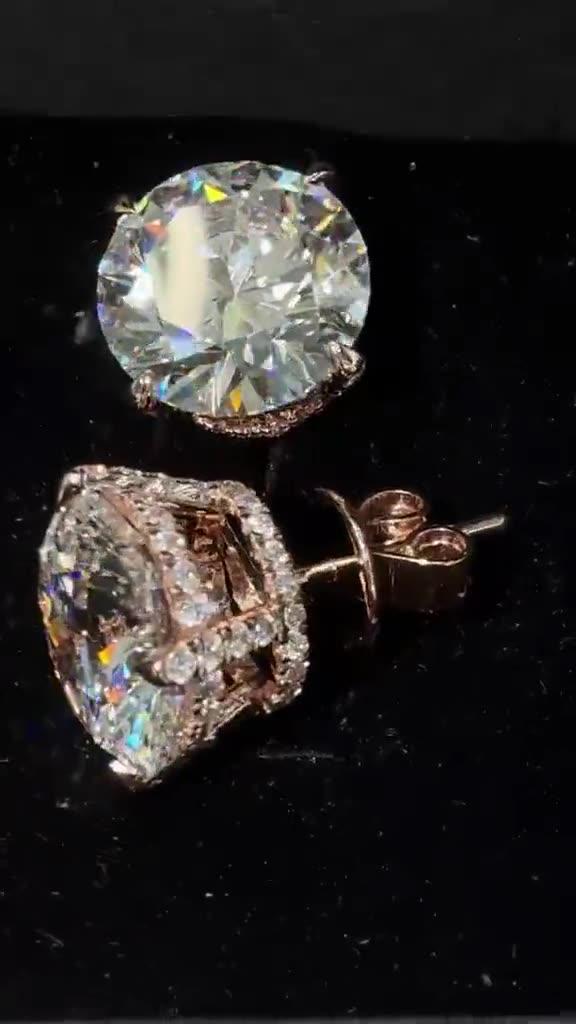
A four-claw setting lifts the diamond and lets light in from the sides, which makes it look larger and brighter. A three-claw does the same with less metal in the way. A rubover — a rim of metal all the way round, also called a bezel — protects the girdle completely and is the setting to choose for someone who is hard on jewellery or works with their hands, at the cost of the stone reading slightly smaller.
The back matters more than people expect
This is where earrings are actually lost. A butterfly back is the standard push-on fitting and it works loose over a day. A screw-back threads onto the post and is very secure but slow to put on. An alpha or lever back sits between the two — it clicks shut and stays shut. For anything valuable, ask for screw or alpha backs rather than accepting butterflies by default; it is a small cost against losing one of a pair.
Weight, if you wear them daily
A heavy drop worn every day will stretch a piercing over years. It is a real consideration rather than a sales one, and it is the reason substantial earrings are often made in white gold or platinum over a lighter framework rather than solid throughout. Ask what a pair weighs before committing to wearing them constantly.
FAQS
Almost always the pair. A pair described as one carat is normally two diamonds of roughly half a carat each. It is the single most common misunderstanding in earrings, and it is worth confirming in writing before comparing two prices — a pair of one-carat stones and a one-carat total-weight pair are very different pieces at very different prices.
Because the two stones have to match. A pair needs diamonds of the same colour, clarity, cut and proportion so they look identical on either side of a face, and finding a true match is harder than finding either stone on its own. That matching is a real part of the value, and it is why a well-matched pair holds its worth better than two mismatched stones of the same total weight.
Screw backs are the most secure — the post is threaded and the back winds on, so it cannot be knocked off. Alpha or lever backs are nearly as secure and much faster to fasten. Butterfly backs are the common push-on fitting and are the least secure of the three; they loosen through the day and are how most earrings are lost. We can fit screw or alpha backs to any pair.
Yes, and it is a large part of what we do. Bring the ring in so the setting style, metal colour and stone character can be matched properly at the bench — photographs are not enough to match a metal tone or a claw profile. We can work to a pair of stones you already have, or source stones matched to the ring.